

On 29 April 1612, Bishop Carlo Bascapè founded the Confraternity of the Good Death, or Company of Death, ad defunctorum animas adiuvandas, which in 1616 was affiliated with the Archconfraternity of Death in Rome, obtaining indulgences and privileges.
Its purpose was to pray for the souls of the dead, keeping alive an awareness of the ultimate realities – the novissimi, death, judgment, hell, and paradise – which offer essential clarity and a precise reference to the meaning of every person’s life and death.
Used to nuances and sensitive to the chiaroscuro of the spirit, and given that modern spirituality is sometimes superficially regarded as an excessive simplification, and that we ourselves are often engaged in trying to forget or exorcise death, it may seem strange that a large chapel should be dedicated to death—indeed, to the Good Death
Yet the confraternity members, dressed in black, governed by eight laymen elected each year and led by a prior chosen from among the most distinguished citizens, were undoubtedly rich in spirit, faith, and a strong sense of community, as evidenced by the many documents relating to the confraternity, later also known as the Confraternity of Suffrage. To mention just a few:
– 9 July 1619: agreement with the painter Pier Francesco Mazzucchelli, known as Morazzone, for the decoration of the chapel;
– 28 July 1619: agreement with the stucco artist Giovanni Battista Giannone to execute the stucco decorations;
– 16 September 1644: agreement with master craftsman Francesco Appiani for the construction of a walnut credence adorned with carvings of David, the Sibyls, and the saints of suffrage;
– 1795: agreement with engineer Stefano Melchioni for the construction of the altar.
This indicates that alongside spiritual devotion there was also a substantial amount of money and property, all derived from offerings, which the confraternity administered, focusing primarily on having Masses celebrated in suffrage for the dead. The splendid chapel itself, the result of a highlevel patronage, is clear testimony to this abundance of resources.
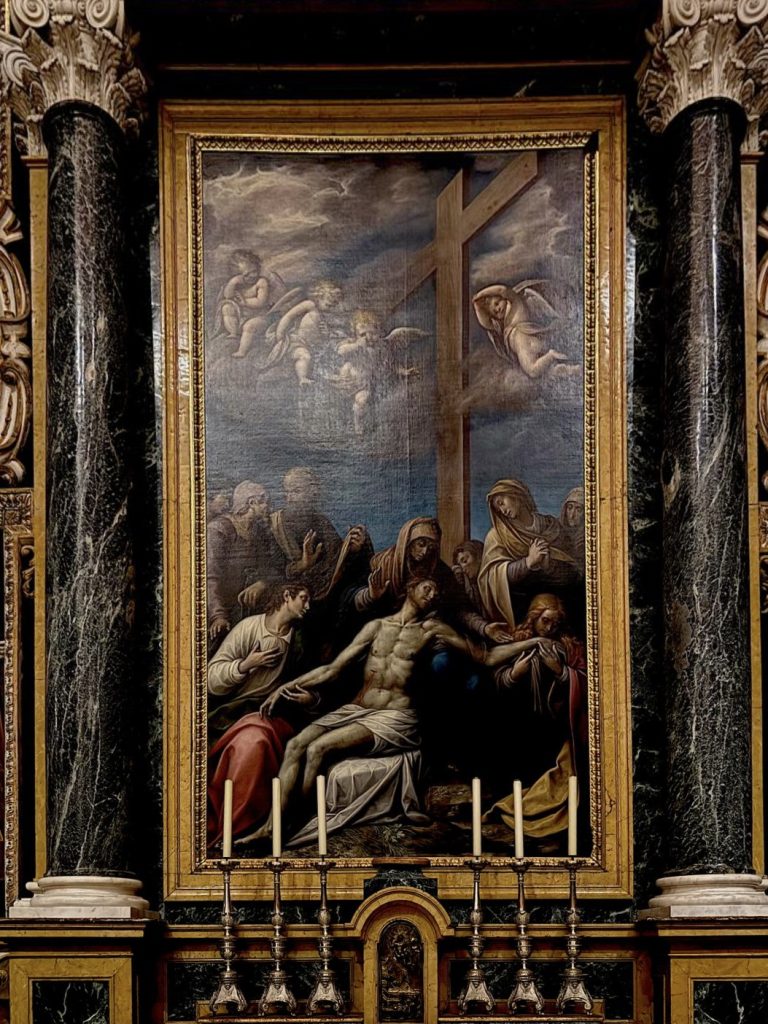
During the pastoral visit of Bishop Giulio Maria Odescalchi (1657), it is noted that the chapel “bene se habet” (is in good condition). As early as 1620, as recorded on the commemorative plaque, it had already been adorned with Morazzone’s frescoes and crowned by his large canvas depicting the Pietà. This extraordinary ensemble is the finest vessel for the great message of the Sorrowful Mother: the focal point of the chapel and the heart of the message conveyed to the faithful through imagery. Not so much because death is avoided (even that of Christ), but rather because it emphasizes that this death redeems every human being, saving them from the horror of death and giving rise to a greater hope.
From here unfolds the entire iconographic program, entrusted with bearing witness to the evolution of thought that, beginning with the faith of Israel, arrives at the faith of the Church. From prayer for the dead, to the idea that such prayer has meaning; from hope for a reward and fear of punishment, to the awareness that death cannot be understood merely as a despairing deprivation of life, but as a mystery within which life is reborn—provided one has the courage, as Paul suggests in his scroll, to “seek the things that are above, where Christ is, seated at the right hand of God the Father” (Colossians 3). Indeed, Paul appears in one of the panels as a witness of the New Testament, together with John, who proclaims the words of chapter 21 of Revelation: “Nothing unclean shall enter it” (the New Jerusalem), where unclean refers to “anyone who practices corruption and falsehood.”
On the opposite side, David and Isaiah bear witness to an older and less defined hope: “No eye has ever seen a God besides you, who acts on behalf of those who hope in him” (Isaiah 64), and from David’s Psalm 17 (16): “I shall be satisfied with your presence.” Simeon, facing what appears as a long journey of approach and a gradual understanding of the meaning of life and death, is joined by other great biblical figures: two from the Old Testament – Ruth and Judas Maccabeus – and two from the history of the Church—Saint Odilo and Saint Gregory the Great.
First among them is Ruth. “May the Lord show kindness to you, as you have shown kindness to my dead” (Ruth 1), says Noemi to her Moabite daughters-in-law, widowed by the death of her sons. Ruth, with an open heart and steadfast faith, stands faithfully beside her mother-in-law and, embracing the faith of the God of Israel, gets married. As her reward, she becomes the progenitor of the Messiah, through a descendant of David.
The Second Book of Maccabees testifies: “According to the traditions of the people and of the Temple, it is a holy and pious thing to pray for the dead, in the hope of the resurrection” (2 Maccabees 12).
The believers’ awareness grows in depth and intensity. The two great figures below testify to the deep faith of the Church, which fully understands the efficacy, in Christ, of intercessory prayer for the dead. Saint Odilo is recalled for the institution of the commemoration of all the faithful departed, while Saint Gregory the Great is remembered for the inspired dream through which, in the image of the suffering Christ, he intuited the importance of celebrating the Eucharist in suffrage for the dead.
Of great vividness is the scene beside the window on the left. At the bedside of a dying man, a demon attempts to open a large book—the book of life—in which all human debts are recorded. With an authoritative gesture, an angel closes it, indicating that there is no debt that cannot be forgiven through Christ’s sacrifice, if one entrusts oneself to Him with faith. On the opposite side is depicted the desolation of death without hope and without God: decomposition, worms, and decay. One must therefore choose a good death and be worthy of it.
Yet God knows humanity, its fragility, and the difficulty of being holy as He is holy. The message expands through a wise alternation of warnings and hope, embodied in the presence of angels: these are the souls in Purgatory, awaiting the end of their purification so that they may enter the glory of Paradise. This waiting can be shortened by the prayers and charity of the living.
Therefore, prayer and penance have meaning; this is what the confraternity recalls through its orations, in a way also celebrating itself, while humbly imploring a final exhortation of admonition and catechesis. The lavish decorations, with symbols of the transience of earthly goods and human vanities, reaffirm that, according to the words of Saint Paul, everything belongs to us—but not to Christ, and even less to death; rather, it should remind us of these truths and, in any case, will always be aided by the piety of believers.
On the left side, “the formidable Morazzone,” as Prina wrote in 1711, “has struck terror into all painters with his original Last Judgment placed along the side of the Chapel”: the enormous canvas (640 × 274 cm) is a powerful and dazzling interpretation of the judgment.iatico sicuro per raggiungerla.
On the left side, “the formidable Morazzone,” as Prina wrote in 1711, “has struck terror into all painters with his original Last Judgment placed along the side of the Chapel”: the enormous canvas (640 × 274 cm) is a powerful and dazzling interpretation of the judgment.