The Chapel of the Guardian Angel
Marina Dell’Omo
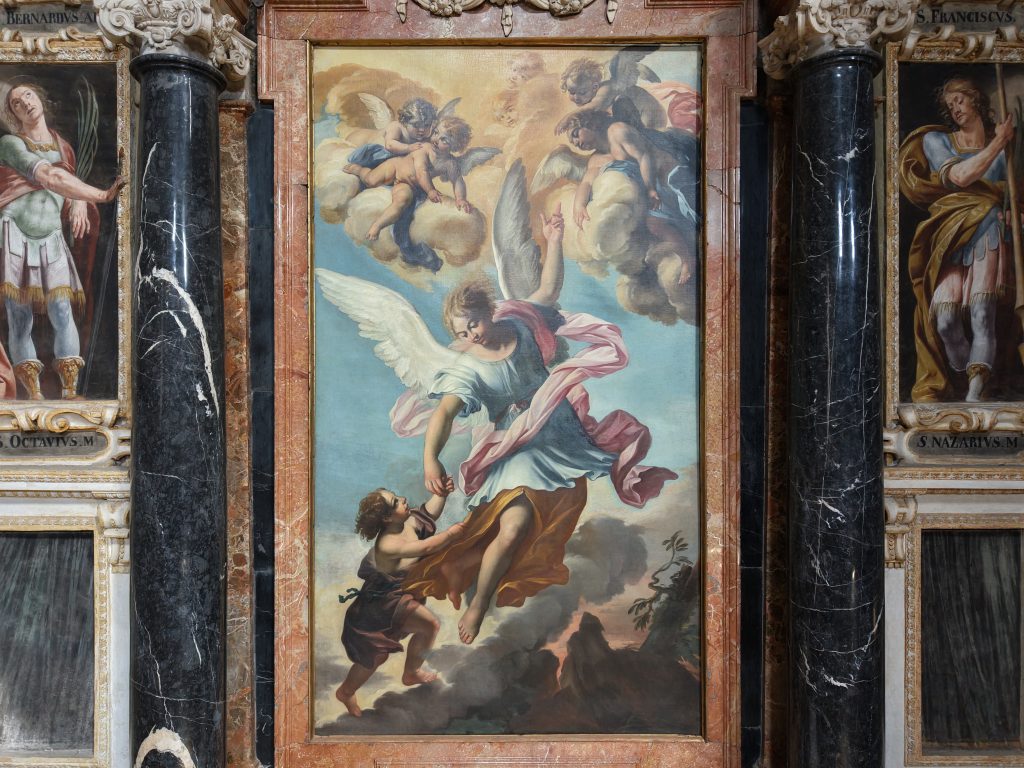


The fortunate discovery of the inventory of the posthumous estate of Ottavio Nazari, drawn up on 20 November 1645, has made it possible to reconstruct in detail the history of the chapel dedicated to the Guardian Angel, erected by Nazari himself in the Basilica of San Gaudenzio, and to gain insight into his artistic tastes.
The inventory, in fact, includes among the notarial instruments drafted by Nazari over the course of his life those relating to the construction of the chapel, including the agreements stipulated with the various craftsmen involved.
Ottavio Nazari drew up his will on 25 September 1630, implying that by that date the chapel was practically completed, whereas in reality only a few finishing touches to the altarpiece were still lacking. This can be inferred from the wills of 1634 and subsequent years, and in particular from several invoices concerning the marble altar, which indeed bears the date 1633.
The deed assigning the sacellum, which was to occupy the site of a pre-existing chapel dedicated to Saint Eligius, was stipulated with the canons on 27 February 1627. Nazari, however, without waiting for the official approval of the canons—which evidently followed shortly thereafter—had already drawn up an agreement with Tanzio on 19 February 1627 for the execution of the painted decoration.
Presumably, even earlier, he had reached an agreement with the stucco workers Giovanni Pietro and Antonio Maria Casella, for whom a single payment contract survives, dated 8 May, for the sum of 180 lire and five and a half brente of wine. After this deed, the documentation falls silent until 1629.
On 10 January of that year, Nazari received the official concession of the chapel from the decurions of Novara, who held civic patronage over the church. On 15 June 1629, a notarial act records a confesso to Tanzio for 1,000 imperial lire «solutione mercedis picturas quas Antonius pingit in capella […] que de picturis ornatur expensis dicti Octavii et hoc quantitatis quibusque confessionibus ab hodie». This payment does not appear to have been the final one, although it is likely that the frescoes were completed by the end of 1629, as shown by the date and signature placed by the painter in the sanctuary.
It is likely that Tanzio did not begin work immediately after signing the contract—which required completion within twelve months—and that the painting was undertaken only after the stucco work had been completed. Confirmation that the decoration was finished in those same years is also provided by a confesso dated 4 January 1629, issued by Francesco Cattaneo for the stucco decoration of the arch of the altarpiece to Fossati. To the initial payment was added the invoice for the marble altarpiece, to be executed on the basis of a design by the Milanese ducal architect Francesco Maria Richini. For the altarpiece, whose contract stipulated a payment of 3,300 imperial lire, considerable interest attaches to the Fossati family, members of a family of itinerant marble workers, who would again be involved at the end of the seventeenth century in the decorative apparatus of the Chapel of the Madonna of Loreto. In this case, their involvement was presumably mediated by the Casella stucco workers, given their shared origins in the Ticino region.
On 28 March 1631, a confesso records a payment of 150 lire to Fossati, possibly the final settlement for the work. On 10 March of the same year, Tanzio received 600 imperial lire in full settlement of the 400 scudi agreed upon in the contract of allocation. This final payment most likely also covered the canvas depicting Sennacherib, which was not explicitly mentioned in the contract, although there must have been additional intermediate payments to reach the total of 2,400 lire corresponding to the agreed 400 scudi. The same act emphasizes that the work had been acclaimed as praiseworthy by Nazari himself and by Paolo Gallarati, and that the fulfillment of the expressed vow and the promised work had thus been achieved. Paolo Gallarati had died on 27 March 1629, making it clear that the mandate to evaluate the part of the work completed by the painter by that date—and to authorize the payments—could not yet have included the entire chapel.
The following years, up to 1634, were devoted to further finishing works on the decorative ensemble.
On 28 October 1632, a contract was signed with the magistro cementario Bartolomeo Gabrino for “the installation of marble ornaments in the chapel,” and finally, between 1633 and 1634, additional confessi were issued with the scalpellini Gerolamo Giudici and Antonio Fossa (possibly one of the sons of Silvestro) for further unspecified work.
Within the space of only eight years, the chapel was completed, with a generally unified decorative program, marked by the personal choices of the patron. For the pictorial component, Nazari must have sought advice—perhaps initially—from Canon Giovan Battista Gibellini, who was also responsible for devising the iconographic program of the sacellum.
The execution of the painting for the altarpiece remained outside the scope of the works, as it was not included in the contract with Tanzio. However, it cannot be ruled out that serious arrangements had also been made with the same artist, which could not be fulfilled due to his death.
A sketch by Tanzio depicting the Guardian Angel is in fact recorded by Bianchini in 1828, together with one of Sennacherib and a painting of Judith by the same artist in the Bayo gallery—heirs, presumably, along with the Nazari palace, to part of the family’s picture collection. In 1870, the inventory of Giuseppe Avogadro still recorded the Sennacherib and the Judith, while all trace of the Guardian Angel had been lost.
As for this last work, it is worth hypothesizing some of its later movements. In Ottavio’s own inventory, drawn up at the time of the division of the paintings among his heirs in 1657, there is mention, in the study of the house, of “a painting of the Guardian Angel on canvas with a frame, guiding man along the road to heaven, which is still at the altar of the chapel of San Gaudenzio.” The same painting is later consistently cited in the inventories of the Nazari heirs’ collections, without any reference to its use in the chapel at San Gaudenzio.
It may be identified with the image of this subject that Bishop Giulio Maria Odescalchi recorded in 1657 during his visit of the church on the altar of the chapel, lamenting that it was “valde parva in comparatione iconica” (“very small in comparison to the iconography”). To remedy this deficiency, Ottavio’s heirs – Carlo and his brothers – promised to intervene, but in reality the altar was only completed later with the arrival of the Guardian Angel painting by Giacinto Brandi. But this is another story, one that still awaits further investigation.