The Chapel of Our Lady of Loreto
Marina Dell’Omo
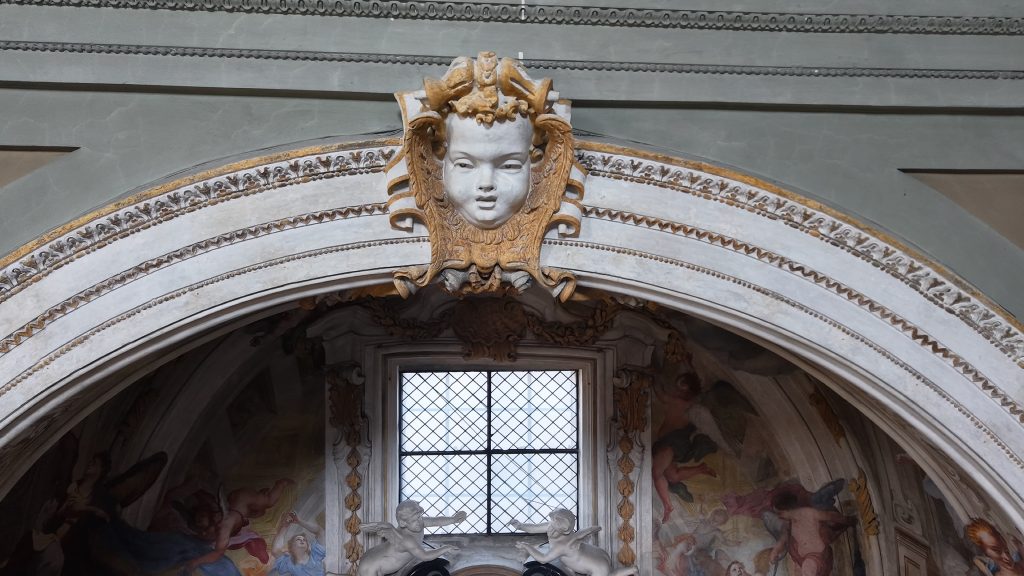
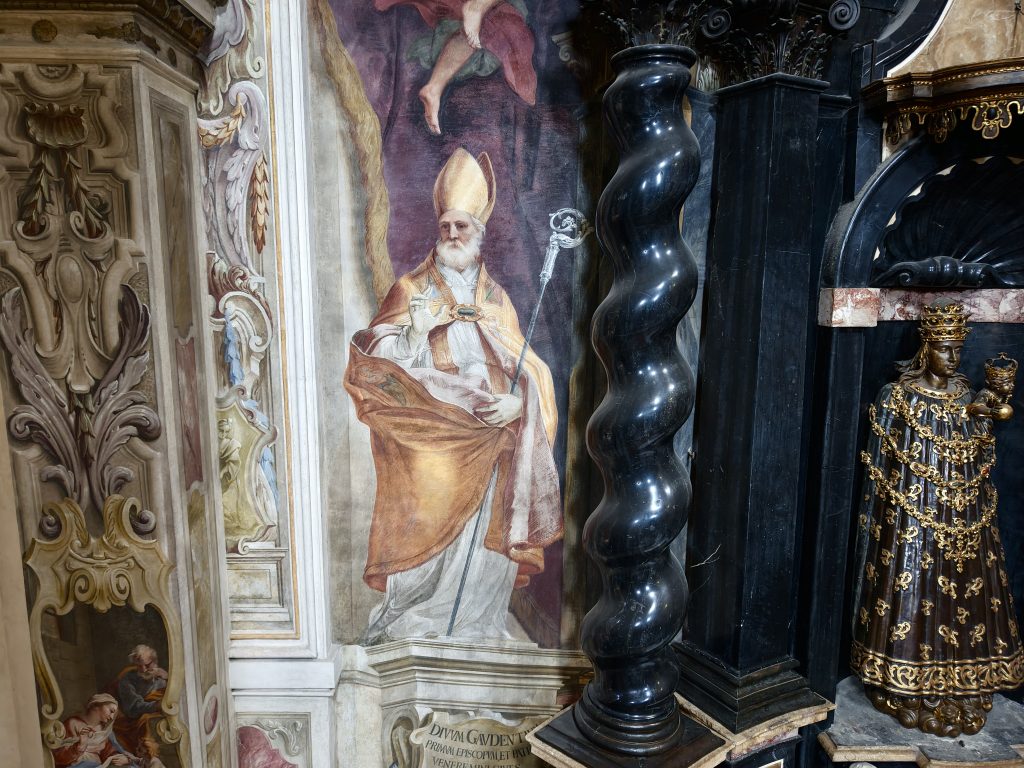
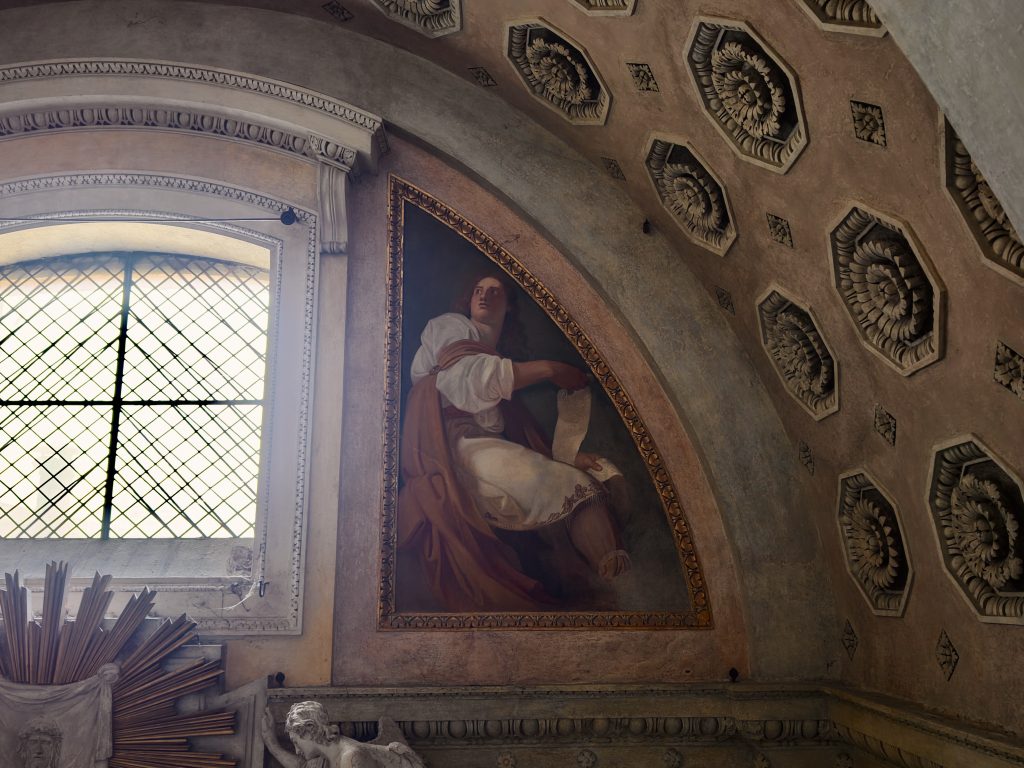
On 6 April 1691, the fabbricieri of San Gaudenzio made their choice of the painter to be entrusted with decorating the dome of the scurolo. The decision lay between Stefano Maria Legnani and Andrea Lanzani, artists whose works were held in comparable esteem. The final preference fell to Legnanino, motivated by the fact that his works displayed “a certain liveliness of colour and mobility of thought.”
The two artists considered by the Fabbrica Lapidea for the decoration of the vault of the Novara sacellum were the most authoritative representatives of late seventeenth-century Milanese painting.
Of the two, Lanzani (1641–1712) nevertheless possessed a richer résumé than his colleague, including a long and successful stay in Rome, followed by participation in the important building site of San Paolo in Aliferi. Legnanino (1661–1713), on the other hand, had favoured a distinctly Bolognese education, with fewer influences from the Roman milieu, as Luigi Lanzi had already implied when highlighting in the painter’s style “a certain density and brilliance of colour that did not know how to derive from Maratta.” His stay in Bologna—where Carlo Cignani must have been his principal reference—nurtured his already innate inclination toward painted skies and luminous polychromies through observation of Domenico Maria Canuti, a true model for large-scale decoration, also shaped by Roman experiences. Not least, the study of Correggio’s domes must have played a role, from which Legnanino drew evocative working cues throughout his career.
Thanks to this formative background, in the penultimate decade of the seventeenth century Legnanino began to accumulate a number of prestigious commissions between Lombardy and its capital. In Milan, in particular, in 1687 he executed the fresco of the Coronation of the Virgin for the entrance arch of the church of Sant’Angelo ai Frati Minori; in Monza, from 1690 onward, he worked for the Cathedral on projects that confirmed the qualities emphasized in the Novara document. The commission for the scurolo thus represented a further step in his advancing career, which would culminate prestigiously in the Turin site of Palazzo Carignano. The Gaudenzian intervention was undoubtedly his first in the Diocese of Novara, followed, between the last decade of the seventeenth century and the early eighteenth century, by a series of commissions along the Riviera d’Orta, connected to work at the Sacro Monte. In 1692, in fact, a Nativity of Mary was delivered for the chapel of the same name on the ascent to the Sacro Monte, placed alongside works by Carlo Francesco Nuvolone, while between 1696 and 1700 Legnanino would return to Novara to execute two decorative schemes in the Chapel of Saint Joseph in the Cathedral.
The execution of the frescoes in the scurolo, like all works concerning the Holy Sepulchre, is precisely documented in the archives of the Fabbrica Lapidea. To these indispensable sources are added the slightly later accounts of Lazaro Agostino Cotta, a highly reliable witness, especially for works of his own time, who notes the involvement of Federico Bizzozzero alongside Legnanino for the quadratura. This presence does not appear in the payments recorded by the Fabbrica, perhaps because Bizzozzero was paid directly by Legnanino, to whom the entire conception of the decoration was in any case owed. The painter provided a preparatory sketch, later recorded as being in the collection of the Novara Cacciapiatti family, subsequently dispersed and only recently rediscovered and currently under study. The work was completed by 26 January 1692, as evidenced by a payment made “in full satisfaction for having painted the dome,” and the result was absolutely exemplary for Novara: for the first time, a glory was painted according to a modern typology whose models were found in the churches of the capital of Christendom.
The ceiling of the sacellum is in fact painted with gilded fictive coffers, at the centre of which is a simulated small dome, beyond which the Trinity is glimpsed. From this centre radiate clusters of clouds, cherubs, and angels—some bearing episcopal symbols, others musical instruments—who seize Gaudenzio and draw him into the glory of heaven. The painter fuses painting and architecture, abolishing the real space of the vault and recreating it as a fictive continuum between heaven and earth. The clouds seem to descend from the open cupola, beyond the material surface of the vault, in a swirling vortex; the figures, conceived to be viewed from below, are dynamic and, all depicted in joyous celebration of the saint’s triumph.
No explicit judgments by the patrons regarding this work appear in the documents, beyond the acknowledgment implied by the final payment. Nevertheless, the quality of the execution must have been remarkable, since shortly thereafter Legnanino was again summoned to decorate the Chapel of Our Lady of Loreto.
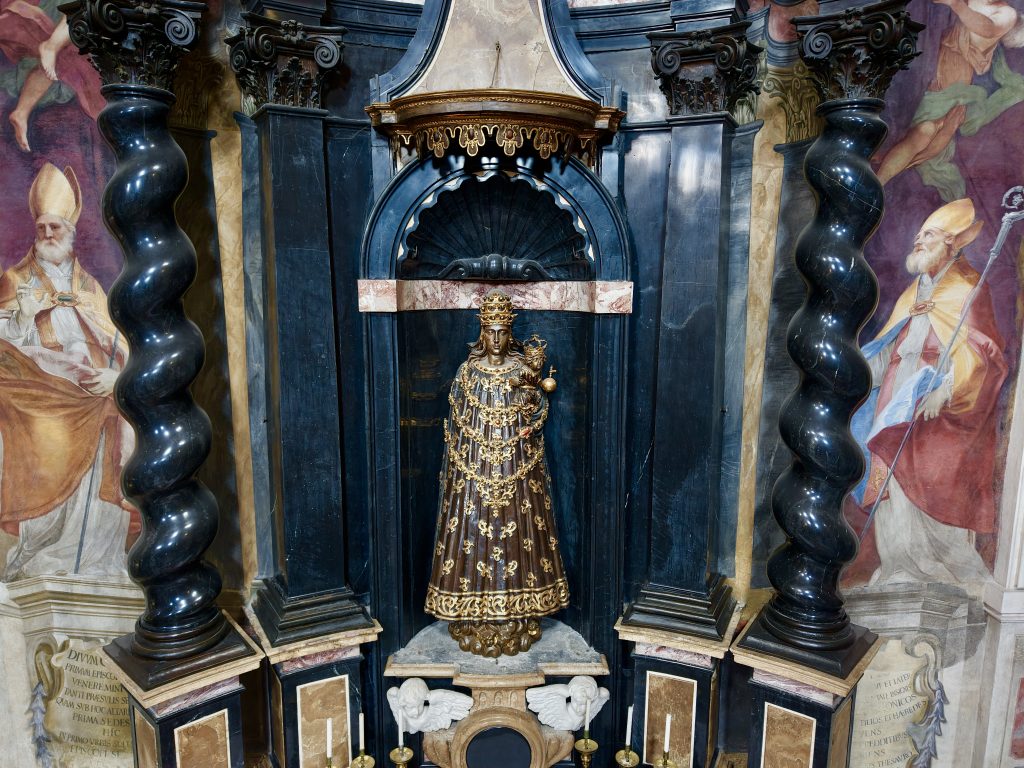
This sacellum, already endowed with a substantial bequest by Bishop Giovanni Ambrogio Caccia in his last will dated 22 February 1629, received its full definition only from 1693 onward, at a time close to that of the initial execution of the scurolo and with a partially similar choice of artists. The cultural climate had by then completely changed from the period in which the generous prelate Caccia had expressed his wishes for the furnishing of the area of the church under his patronage. In the intervening years, the great Baroque had fully taken root—always with a distinctly Lombard character. For the design of the altar, Federico Bizzozzero was once again entrusted with the task, while the decoration is to be attributed to Stefano Maria Legnani, who had evidently achieved the most convincing results in the work carried out in the scurolo of San Gaudenzio.
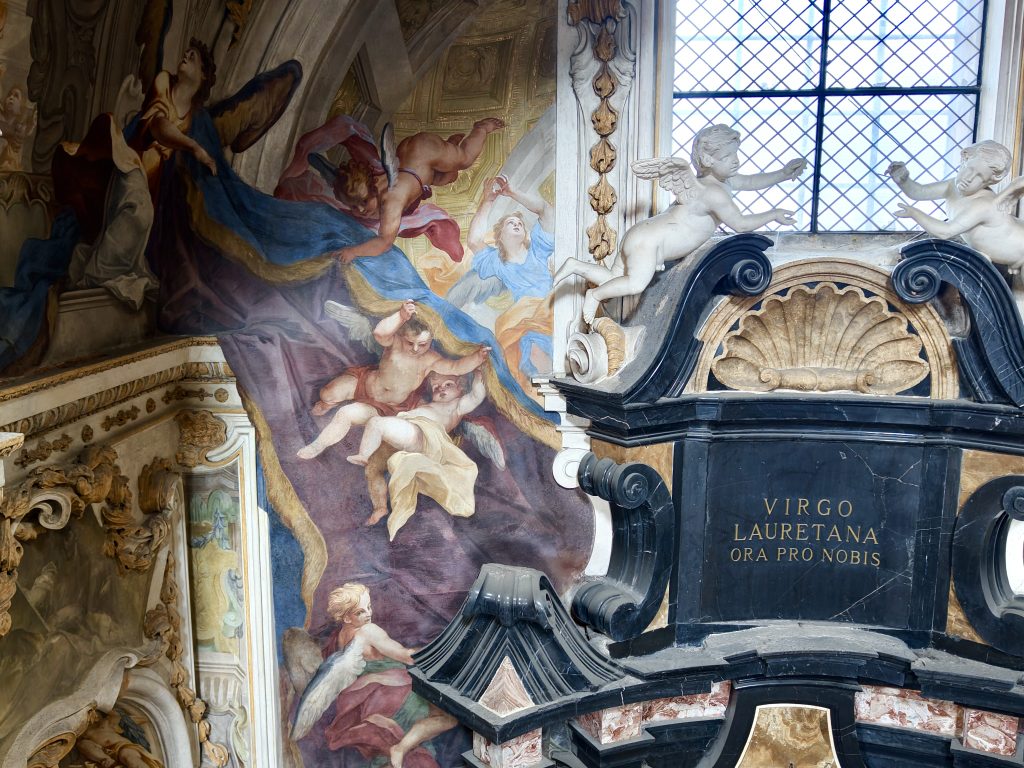
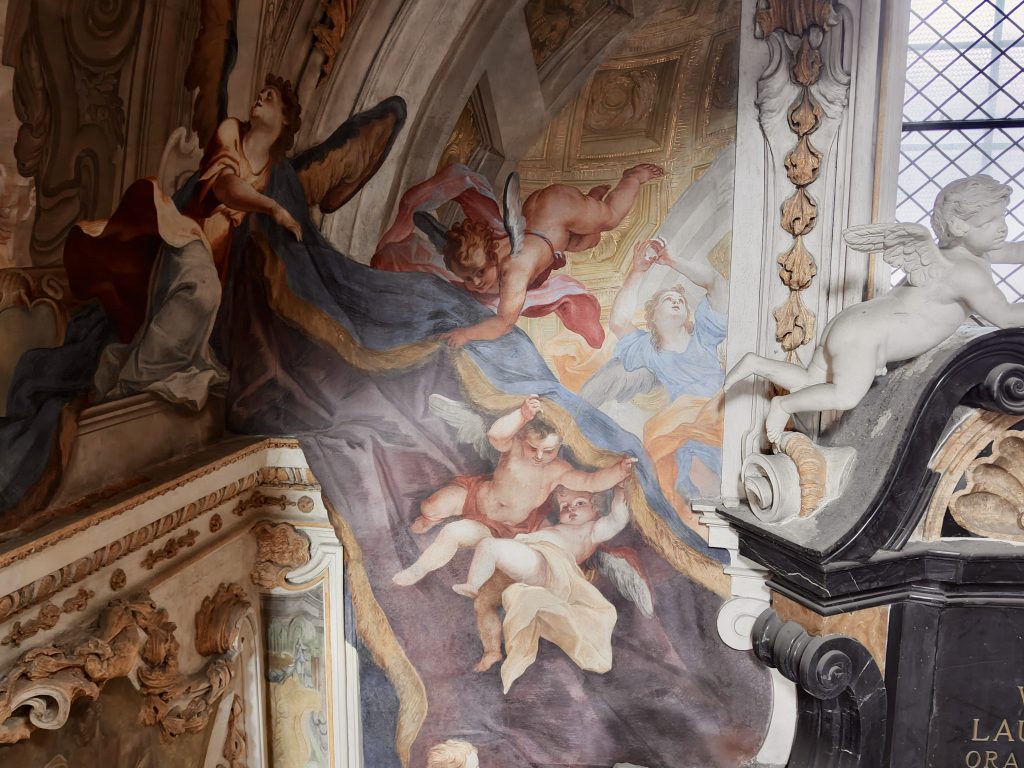
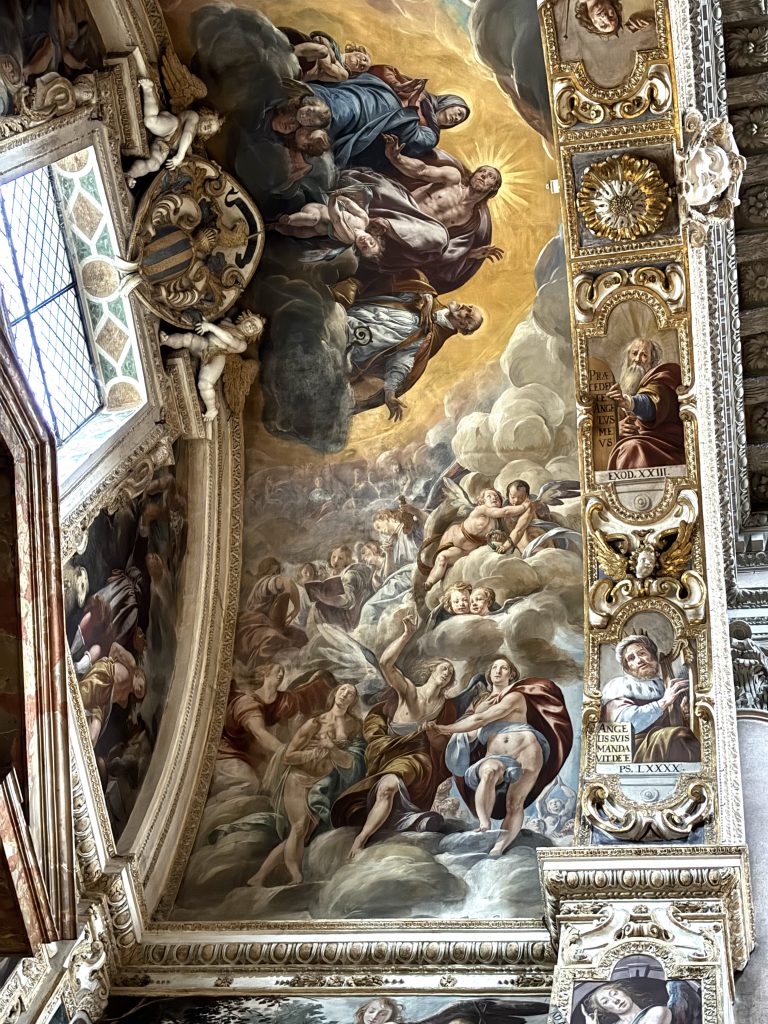
The ceiling of the Chapel of Our Lady of Loreto, like that of the scurolo, presents a highly modern illusionistic rendering. Full-length figures of angels and saints, immersed in heavenly glory, are drawn into a boundless spatiality articulated through vast openings of sky. Everything contributes to defining an ascending movement that reaches its apex in the presence of the Virgin, toward whom a jubilant multitude rises. The result is a mystical and emotional tension that constitutes one of Legnanino’s most successful achievements and stands among the pinnacles of sacred decoration in late-seventeenth-century Novara.
The painted architectural framework—composed of gilded frames, stucco elements, and illusionistic quadratura—connects seamlessly with the actual structure of the chapel, dissolving the boundary between physical architecture and pictorial fiction. Figures and clouds seem to break beyond the limits of ornament, unifying the space into a theatrical, cohesive vision, conceived in dialogue with Roman and Bolognese models. The colour, rich and luminous, intensifies the celestial vortex, while gold accentuates the triumphant dimension, according to a language aimed at wonder and persuasion of the viewer.
The success of the work is registered by contemporary sources, which confirm the satisfaction of the fabbricieri and the complete success of the pictorial intervention, capable of providing the chapel with an apparatus worthy of Loretan devotion. In this context, once again, collaboration with quadratura enhanced Legnanino’s imagination, inclined to dissolve the limits of real space in order to open it to visions of intense spirituality. The programme appears fully coherent with the function of the sacellum and with the taste of patrons of the city, now receptive to the most up-to-date developments of Lombard and Emilian figurative culture.