The Chapel of the Circumcision
Carlo Maria Scaciga


JESU HUMANI
GENERIS
REDEMPTORI
DICATUM
So reads the inscription placed at the top of the second altar on the right-hand side of the basilica, dedicated to the Circumcision of Jesus, “Redeemer of the human race.”
Circumcision is a rite practiced in the East since very ancient times. Its original meaning appears to have been religious and social: an initiation of the young man into puberty and marriage. Ancient Israel also attributed this significance to it; over time, however, the rite became above all the sign of the covenant—the guarantee of God’s faithfulness to His promises and of the people’s faithfulness to the law of their God.
Nevertheless, the spiritual and prophetic meaning of this tradition always celebrated the spirit and inner content of physical circumcision.
Saint Paul develops the thought of the prophets, highlighting the importance of interior circumcision, the only true guarantee of fidelity to the promises made by Yahweh to Abraham. Given the universality of salvation and the spirit of the new Law, which abolishes the prescriptions of the old one, circumcision is no longer necessary. What matters is the essence of that rite: “from the struggle with the old man comes new life in Christ,” which is given to Christians “through baptism, the new circumcision.”
These themes are expressed in the iconography of the chapel with the vividness and determination characteristic of the post–Council of Trent period, when bishops were fully aware of the communicative power of images and therefore acted as precise and highly attentive patrons.
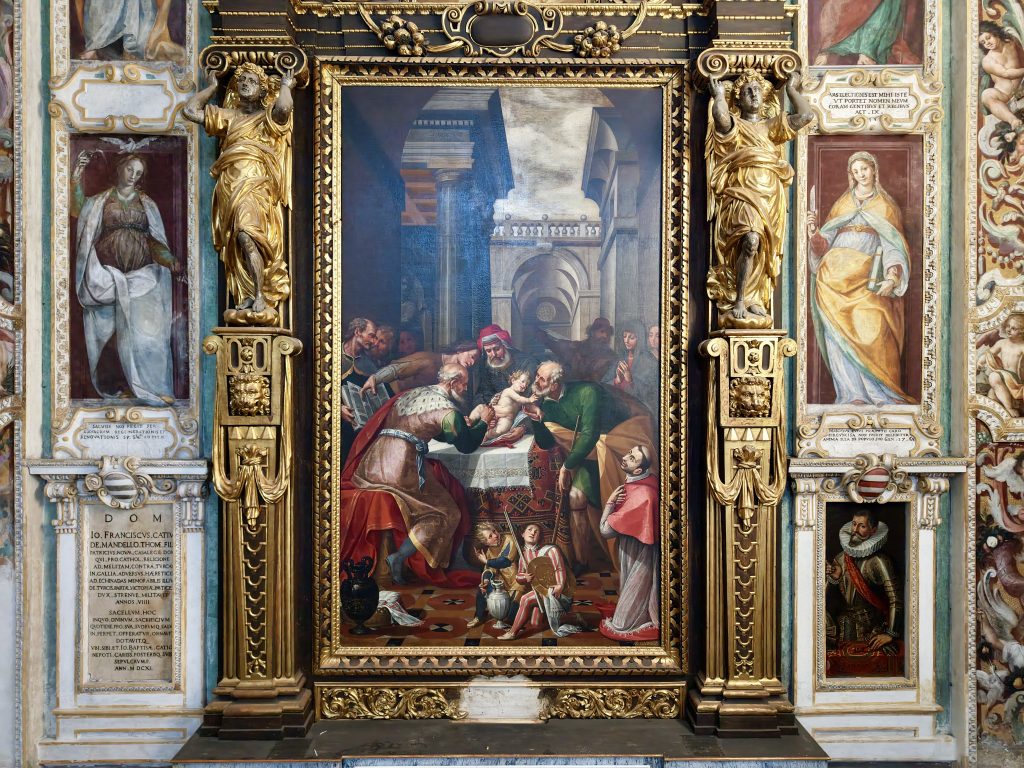
In this case, it is highly likely that behind the conception of this chapel lies the pastoral mind of the great Bishop Carlo Bascapè. This is suggested both by the presence, in the altarpiece, of Saint Charles kneeling in adoration at the lower right, and by the date of the work’s execution.
Indeed, recent restorations have brought to light the signature and date on the large canvas depicting the Circumcision:
JO BATTISTA E JO MAURO
FRATELLI DEL ROVERI DET.
LI FIAMENGHINI FECE
LANO 1612. MILANO
This inscription definitively resolves a long-standing uncertainty of attribution. G. A. Prina, in the seventeenth-century Trionfo di San Gaudenzio, spoke of Battista and Ansalino Fiammenghini; other historians (such as Baroffio in 1929) attributed the work to Giovanni Battista Della Rovere, while Baralis and Picconi, in 1933, named Angelo Everardi.
The brothers Giovan Battista (1561–1627) and Giovan Mauro (1575–1640) Della Rovere, known as the Fiammenghini because of their origins in Antwerp, executed together the altarpiece of the Chapel of the Circumcision.
The canvas has a classical composition: the infant Jesus is circumcised by the priest and supported by the solemn figure of Joseph, while Mary, slightly apart, displays a composed and gentle sweetness.
In this elegant Baroque architectural space appears also the mythical Sibyl, who points with her right hand to the book of ancient pagan wisdom. She is waiting, confused yet trembling, for a savior, and gazes forward toward that child who is about to appear as the fulfillment of all promises and hopes. The seventeenth-century altar supporting the canvas is sober in design, made of white Carrara marble, Verona pink marble, and Crevola blue marble. Of extraordinary craftsmanship is the large wooden frame of the altarpiece, a work from the second half of the seventeenth century, produced by stucco workers and woodcarvers of Lombard-Piedmontese culture.
Recent restorations have also revealed, in the wall decorations, a cartouche bearing the names of the two Fiammenghini brothers and the date 1610. We now know that they worked together on the decoration of the chapel even before executing the altarpiece.
It is on these richly colored surfaces – animated by stucco work, arches, festoons, garlands, and draperies, and traversed by flights of angels – that unfolds the deepest meaning of the event of Jesus’ circumcision. The prophets of the Old Testament—witnesses to fidelity to God, of which circumcision is a sign—Abraham, Moses, Joshua, Isaiah, together with David and Solomon, anticipate in desire a fuller salvation, which circumcision alone cannot achieve (hence the image of the Old Law, a woman holding the knife of circumcision and the book). Only a new covenant can accomplish this: the image of the New Law is represented by another woman, overshadowed by the dove of the Holy Spirit, who with her right hand pours water from above and with her left holds a flame—images of baptism, “the washing,” as the cartouche quoting Titus 3:5 reads, “of regeneration and renewal in the Spirit.”
The new covenant is sealed in the blood of Christ, dead and risen (of which the blood shed in the circumcision is merely an anticipation). From that moment on, circumcision is no longer required; what is required instead is the urgent proclamation of the name of Christ, in whom alone salvation is found.
This explains the two scenes in the lateral lunettes and their inscriptions: “At the name of Jesus every knee should bend, in heaven and on earth and under the earth” (Philippians 2), beneath the great vision of humanity paying homage to Christ; and the other, “In my name they will cast out demons, speak in new tongues, pick up serpents, and if they drink any deadly thing it will not harm them; they will lay hands on the sick, and they will recover” (Mark 16:17–18), beneath the representation of the calling and mission of the disciples, those who are sent “in the name of Christ.”