The Chapel of the Nativity and the Polyptych by Gaudenzio Ferrari
Carlo Maria Scaciga
1590 – During a pastoral visit to the Basilica of San Gaudenzio, Bishop Cesare Speciano notes that the second altar on the left has a canonical form and is a recent construction. Only the altar is mentioned, not the chapel, which therefore had not yet been decorated. The panel painting, attributed to Gaudenzio Ferrari (described by the bishop as “ancient and of great beauty”), is recorded as being placed behind the high altar of the basilica.
1595 – Bishop Carlo Bascapè observes that behind the second chapel stands the altar of the Assumption of the Blessed Virgin Mary. He adds: “It is embellished by a gilded altarpiece, painted most magnificently.” This clearly refers to the polyptych by Gaudenzio Ferrari, which had been transferred here from the high altar. The bishop also mentions the decoration of the chapel.
1618 – On the occasion of the second Taverna pastoral visit, the bishop records that the altar of the Assumption of the Blessed Virgin Mary is richly adorned, with an elaborate frame and a remarkable altarpiece, accompanied by numerous statues and symbols on a fine wrought-iron railing. He notes the presence of a commemorative plaque, a reserved work commissioned by the knight Girolamo Bollini, Knight of Malta, who “took care of adorning this chapel.” The chapel, therefore, had already been decorated.
1629 – Bishop Odescalchi confirms the presence of frescoes and stucco work and notes on the vault the image of the Virgin crowned by the Trinity.
1711 – G. A. Prina, author of The Triumph of Saint Gaudenzio, written for the inauguration of the scurolo and the solemn translation of the saint’s relics, reports that the frescoes are the work of Duchino, a Mannerist painter—namely Paolo Camillo Landriani, known as Duchino (1562–1618).
Duchino
Active in Piedmont and Lombardy from 1591 until his death in Milan in 1618 at the age of fifty-six, Duchino worked within the artistic and cultural climate of post-Tridentine Milan under Archbishops Carlo and Federico Borromeo.
Originally from Ponte in Valtellina and known as Duchino—perhaps because he acted as director of the works carried out at the ducal court in his time—he soon moved to Milan, where he came into contact with the city’s artistic milieu. In those years, following the deaths of the great protagonists of the sixteenth century—Luini, Bramantino, Gaudenzio Ferrari—Lombard painting had become largely academic and closely aligned, in the field of sacred art, with the directives of the Tridentine reform.
Attentive to Michelangelo and rooted in the Lombard sixteenth-century tradition, Duchino represents an example of academic, putto-rich painting, well integrated into this climate and particularly adept at lending decorative brilliance and flourish to large, often ephemeral ceremonial displays. An excellent scenographer, he showed a strong Baroque tendency and a notable talent for illustrating narratives and pictorial cycles.
He was also skilled in the use of every pictorial technique, from fresco to oil, gouache, pouncing, altarpieces, and wall painting. He worked for urban patrons and religious congregations, as well as for rural communities, steadily increasing his reputation until, in 1612, he received the prestigious commission to celebrate the beatification of Carlo Borromeo with a series of large canvases for Milan Cathedral, alongside the younger Morazzone, Cerano, and Procaccini. One year after his death, Borsieri wrote of him: “He was most ingenious in jousts and tournaments, skilled in portraiture and in all that was worthy of wonder, endowed with such talent that, contrary to the custom of other painters, he continued to improve as he aged.”
Ancient judgments seem to contradict the silence of modern criticism and the uneven quality of the works that have survived.
The Decorative Scheme of the Chapel
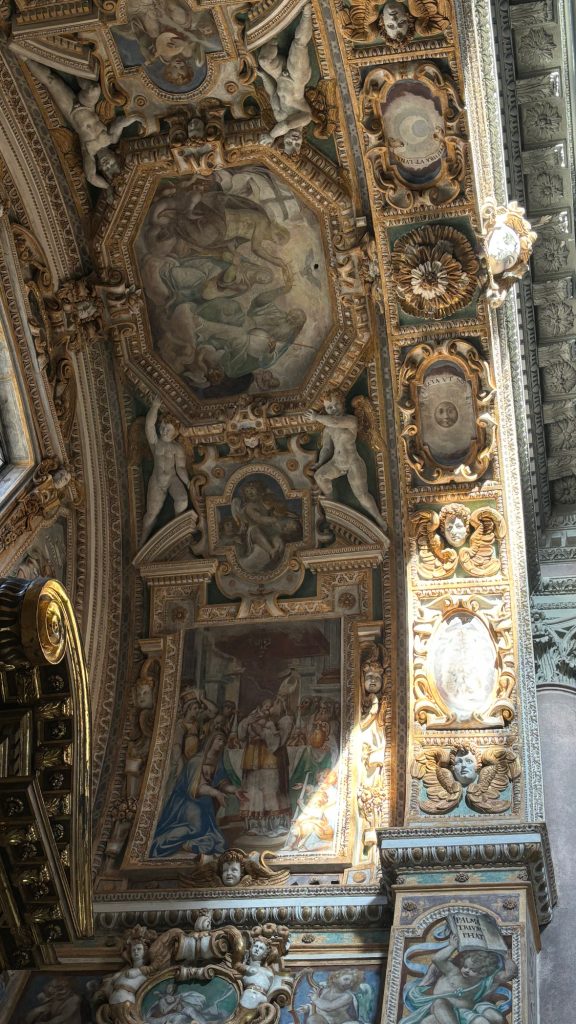
The large framed scenes include: The Presentation of the Virgin in the Temple on the left, The Presentation of Jesus in the Temple on the right, and The Coronation of the Virgin above. There is therefore a correspondence—and above all a profound bond—between the Virgin and the Son: Mary’s life, whether drawn from the Gospel narrative (as in the Presentation of Jesus in the Temple, Luke 2:22 ff.) or from the apocryphal Protoevangelium of James (chapters 7–8, the Presentation of Mary in the Temple), conveys its doctrinal meaning, namely her essential union with the life of her Son. Christians do not pray to Mary, but through Mary to Jesus.
This explains the Marian symbols depicted within oval gilt-stucco frames with scrolls—symbols and invocations taken from the Litany of Loreto and the Litaniae Novae: the Fountain (Fons patens domus Iacob), the waxing Moon (Pulchra ut luna), Jacob’s Ladder (Domus Dei et porta coeli), the Mountain Olive Shoot (Electa ut sol), the Lily (Lilium inter spinas), the Seven-branched Candelabrum (Mater vitae), and the inscriptions Mater misericordiae, Mater salutis, Mater salutis. Around them are angels, winged putti, saints, and allegorical figures of Faith and Hope.
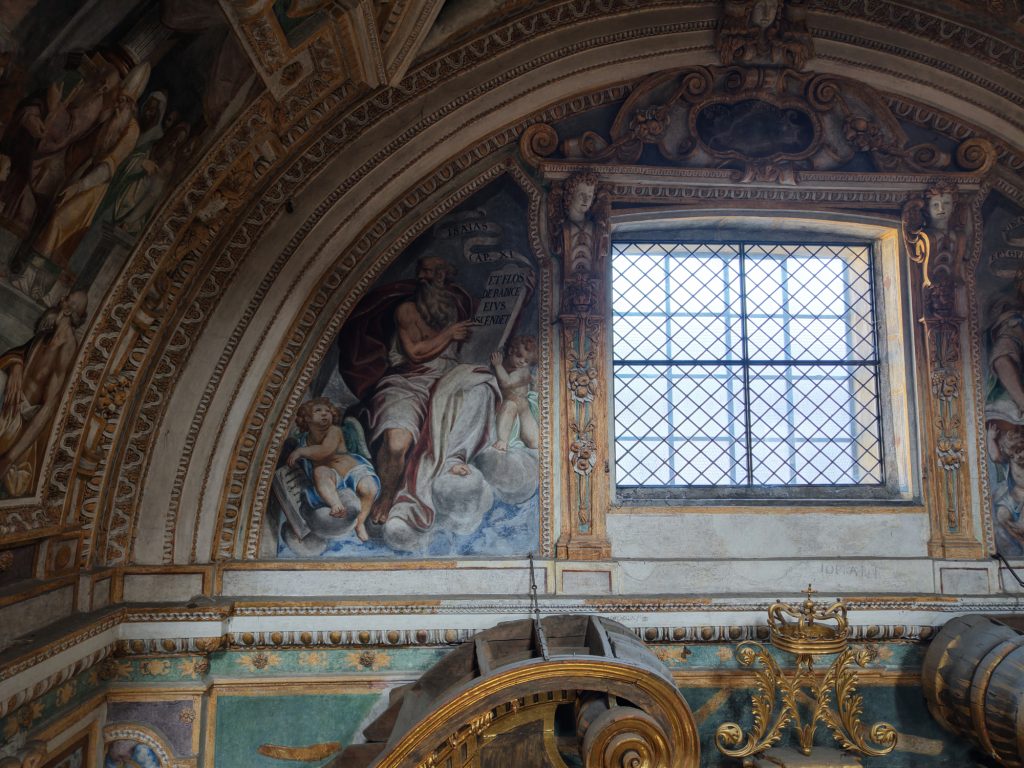
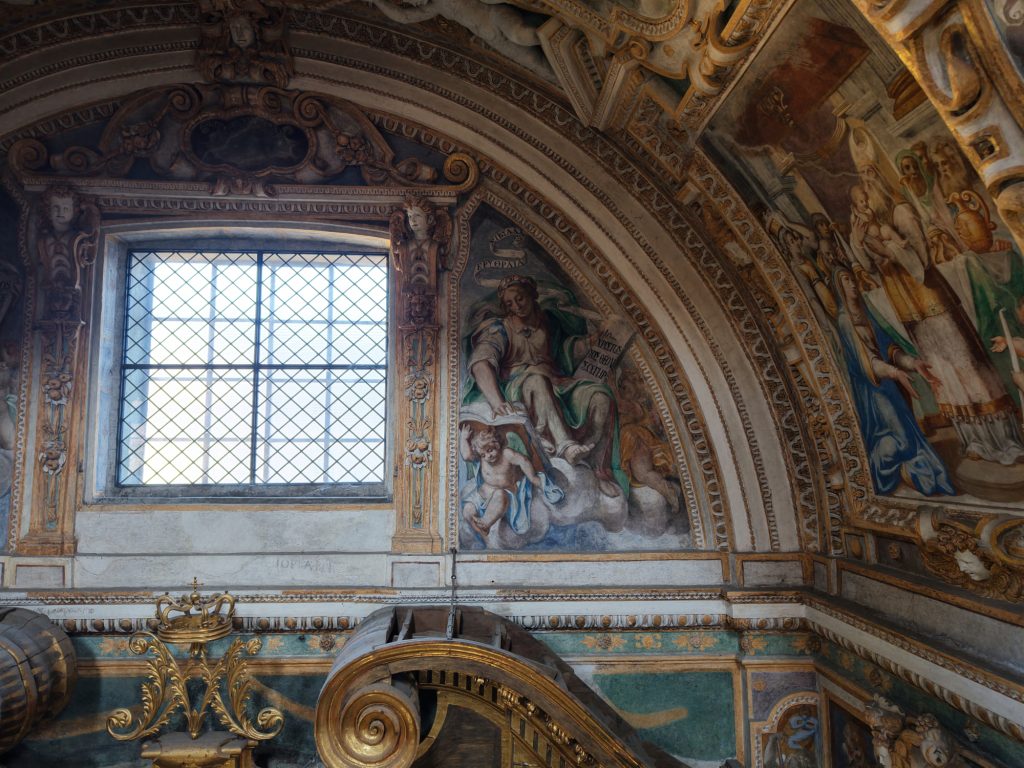
Opposite stand two large figures: on the left the prophet Isaiah, wrapped in his mantle and seated on clouds, holding a tablet bearing the words “Et flos de radice eius ascendet,” where Jesus is the flower sprung from the ancient Davidic root. On the other side is the Eritrean Sibyl, an allegorical female figure endowed with prophetic virtues, who in Christian iconographic tradition represents pagan philosophy and cults, signifying the great expectation of salvation that inhabits the hearts of all humanity.
She represents the pagan counterpart to the prophets and is associated with the announcement of the birth of Jesus; in this instance she holds a scroll inscribed in Greek characters with the words “Jesus Christ, Son of God, Savior.”
Girolamo Bollini
A final, historically and artistically significant reference concerns the portrait of the aforementioned Knight of the Order of Malta, Girolamo Bollini, also dated 1607, placed on the left wall of this chapel and commissioned by Bollini himself from Landriani. This distinguished citizen of Novara, portrayed kneeling in prayer, fought against the Turks in the naval battle near the Curzolari Islands in the Gulf of Patras, where he was wounded and captured. Ransomed after honorably fulfilling the mission entrusted to him by the Grand Master of the Order, he settled in Novara, a city that honored him with various appointments, as Bianchini records.
Bollini is depicted once again near a sacred building closely associated with devotion, such as the basilica, which did not hesitate to impress even the most worldly believers by engaging the most renowned artists. Also this commission reflects a climate of deep fervor and broad consensus, characteristic of a time of more widespread prosperity, in which there was no hesitation in seeking out and preserving what history had handed down.
Il polittico di Gaudenzio Ferrari
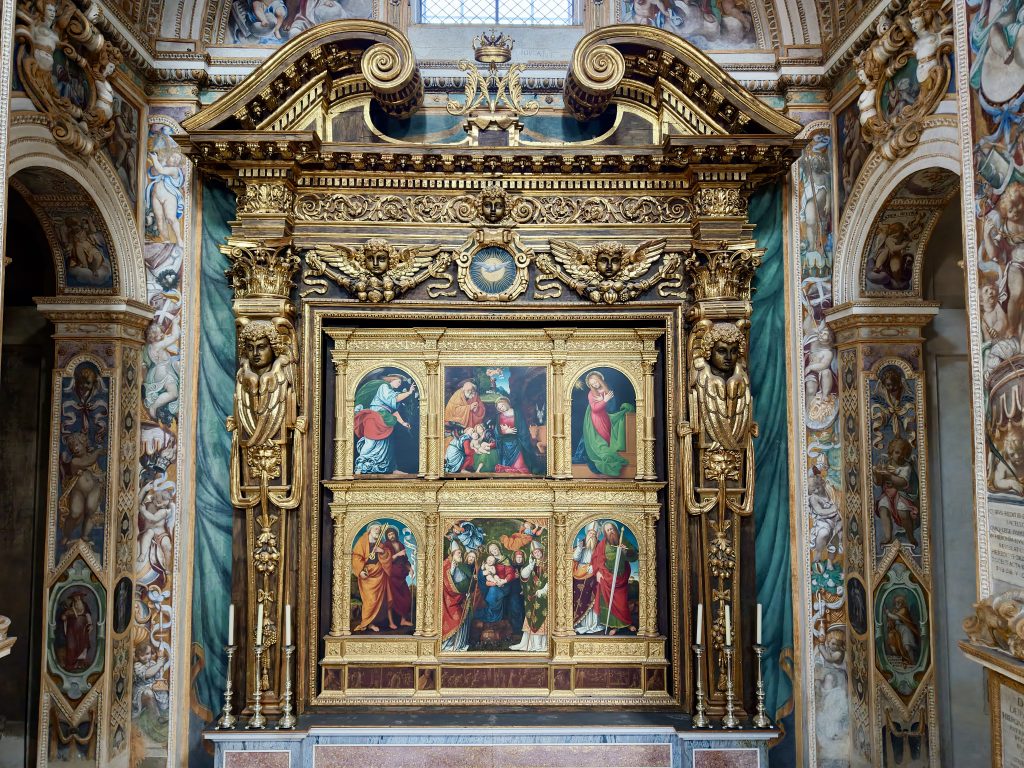
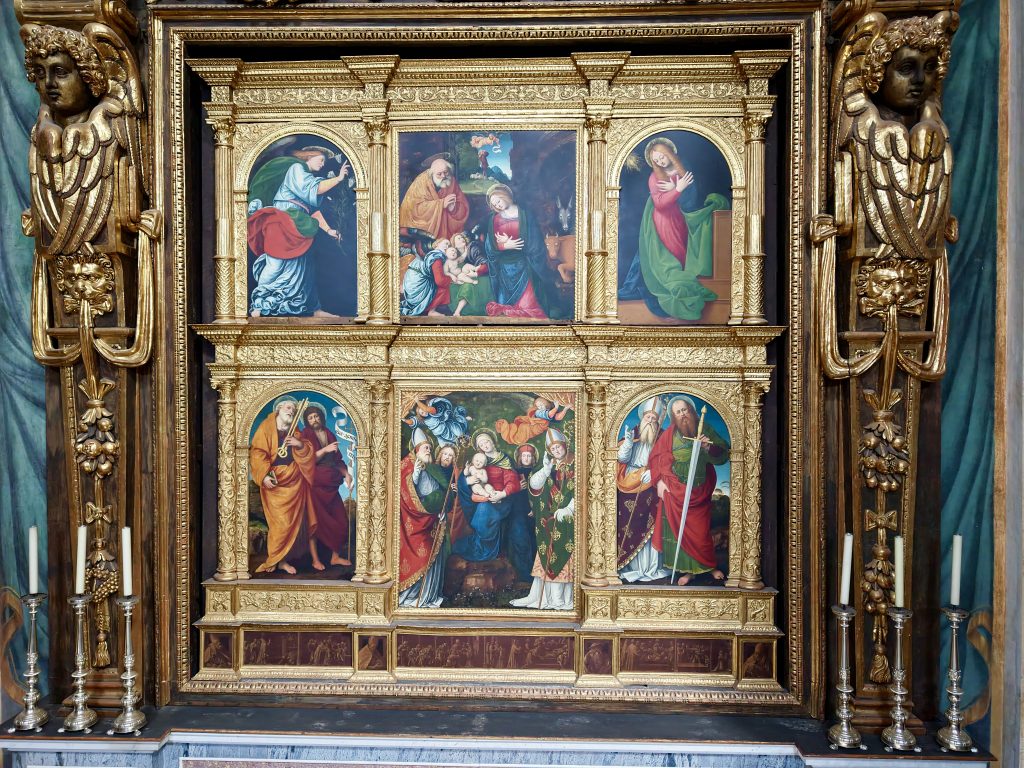
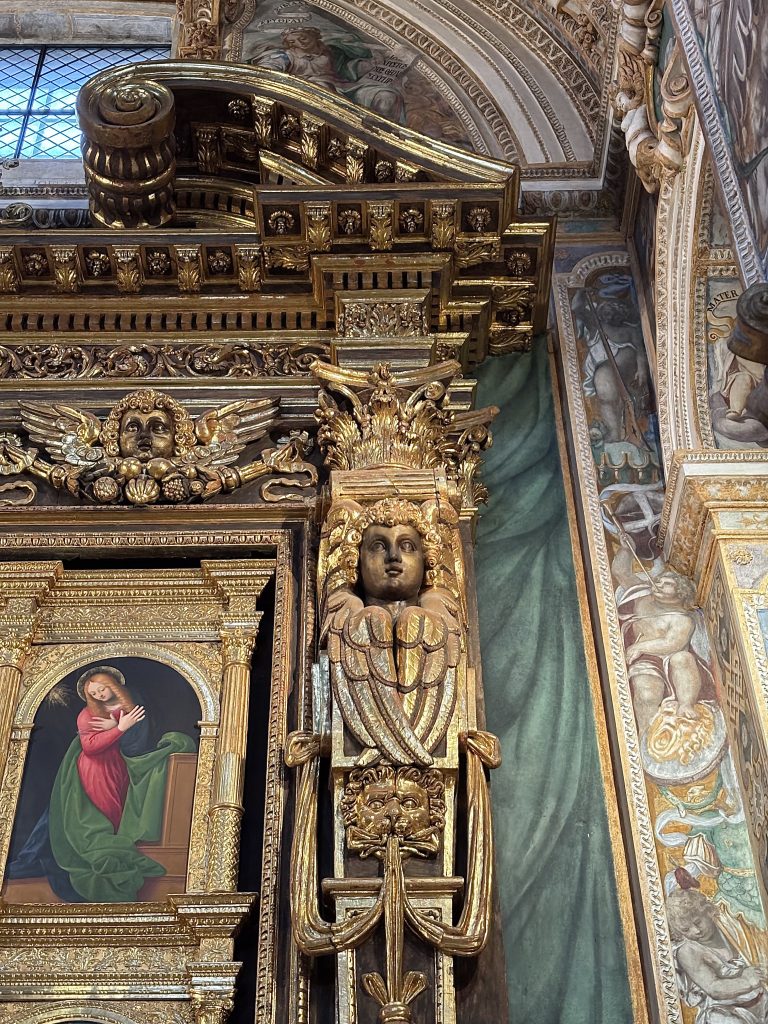
The altar (17th century), made of white Carrara marble, blue Crevola marble, and red Verona marble, is dominated by an imposing gilded wooden frame, a seventeenth-century work by LombardPiedmontese woodcarvers. At the top center, a dove—the symbol of the Holy Spirit—painted within a roundel, surmounts the polyptych by Gaudenzio Ferrari, one of the masterpieces of the great painter from Valsesia (1475/80–1546), commissioned in 1514 by the Chapter of San Gaudenzio for the high altar of the ancient basilica outside the city walls.
It represents an important “relic” of that very ancient church, destroyed during the period of Spanish occupation. Prina described it in 1711 in The Triumph of Saint Gaudenzio as “a distinguished work by the divine Gaudenzio of Novara, pupil of the most gentle and powerful Raphael of Urbino, divided into several panels.”
The altarpiece consists of six compartments: three in the upper register and three in the lower.
In the central upper panel, the largest painting depicts The Nativity, from which the chapel takes its name, while the flanking panels show, respectively, The Announcing Archangel and The Virgin of the Annunciation.
At the center of the lower register, beneath two curtain-holding angels, appears the Sacred Conversation of the Saints with the Child, flanked by Saints Roch and Hugh; in the foreground, to the right of the Virgin, sits Bishop Gaudenzio, and to the left Bishop Ambrose. In the two lateral compartments are Saints Peter and John the Baptist (on the viewer’s left) and Saints Paul and Eusebius (on the right).
Prina further writes: “Beyond the principal figures, the ancona of the Blessed Virgin bears, along its lower edge, certain chiaroscuro sketches expressing the life of the patron saint.”
(predella del polittico – testo continuo)
This refers to the lower section of the polyptych, the predella, where scenes from the Life of Saint Gaudenzio are depicted. It consists of three rectangular panels, interspersed with framed images of four Doctors of the Church, painted half-length. Unlike the saints in the main altarpiece, distinguished by their refined and vivid palette of full colors, the predella presents figures and architectural hints in chiaroscuro against a brown background, with sepia tones lightened and enriched by touches of gilding. This approach shows, on a different level, a stronger sense of spatial depth across multiple planes—an effect that true bas-relief would scarcely have allowed.
In each of the three panels, a small central column divides the depiction of two chronologically successive events from the Life and Miracles of Saint Gaudenzio, for a total of six scenes. In the first panel: (a) Gaudenzio blessing and extinguishing the fire of the city; (b) the meeting of Gaudenzio with Saint Ambrose. In the second: (a) the healings performed by Gaudenzio with the water of ablutions; (b) the death of Gaudenzio. In the third: (a) the miracle of the growth of nails and beard on his corpse; (b) the miracle of the Roman woman freed from the devil.